
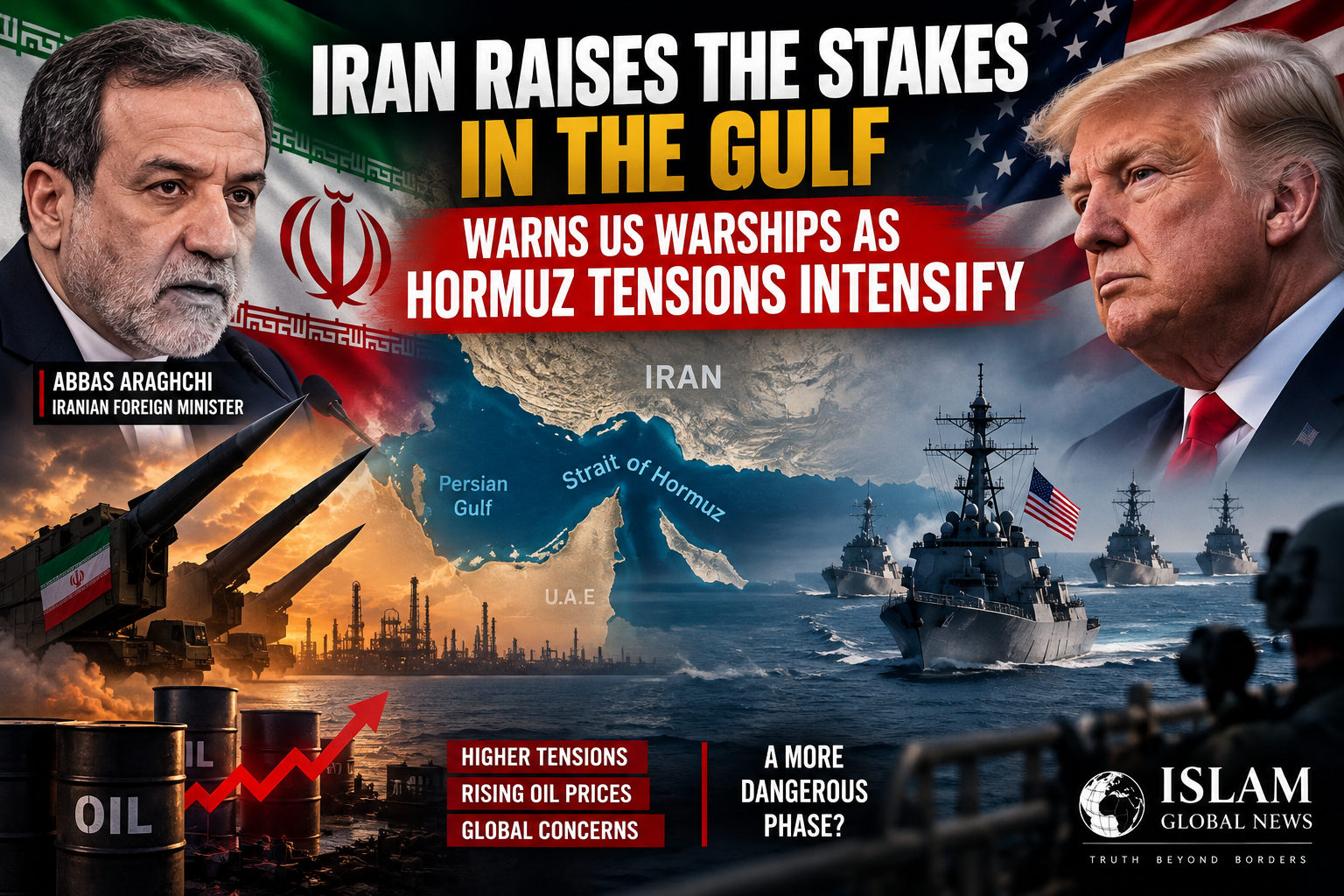
Iran Raises the Stakes in the Gulf, Warns US Warships as Hormuz Tensions Intensify
TEHRAN/WASHINGTON — September 8, 2026:
Tensions between Iran and the United States have entered another dangerous phase after Tehran warned that continued American military and economic pressure could lead to a wider confrontation across the Persian Gulf.
Iranian officials say Tehran is preparing to establish a new maritime “exclusion zone” in the Gulf, potentially extending toward the strategic Strait of Hormuz. The announcement comes as military activity around the waterway intensifies and commercial shipping faces growing uncertainty.
Iran’s Supreme National Security Council Secretary Mohsen Rezaei has warned that Tehran is prepared to take a tougher position against American warships and military bases if Washington continues what Iranian officials describe as economic and military aggression.
The proposed exclusion zone could significantly increase the risks for commercial vessels operating in one of the world’s most important energy corridors. Iranian authorities have not yet provided complete details about the precise boundaries of the proposed zone or how it would be enforced.
Iran Highlights New Missile Capability
At the same time, Tehran has sought to demonstrate that its military capabilities remain intact despite months of conflict.
Iranian officials have highlighted the Qassem Basir, an advanced ballistic missile that Tehran says has improved accuracy and the ability to overcome elements of modern missile-defense and electronic-warfare systems.
Iran has also claimed that the missile was used against U.S. naval forces. However, American officials have disputed Iranian claims regarding attacks on U.S. vessels, meaning that some battlefield assertions remain contested.
The increasingly direct warnings have raised concerns that another military exchange could quickly spread beyond Iranian and American targets.
Strait of Hormuz Becomes the Central Pressure Point
The Strait of Hormuz remains at the heart of the confrontation.
The narrow waterway connects the Persian Gulf with the Gulf of Oman and is one of the most important routes for global energy shipments. Any prolonged disruption could affect oil supplies, shipping costs and energy prices far beyond the Middle East.
Shipping activity has already fallen sharply compared with normal pre-conflict levels. While vessels are still moving through the strait, the reduced traffic reflects the growing security risks facing commercial operators.
Iran has previously sought to influence which routes ships use through the waterway, while the United States has maintained its own military presence and maritime operations in the region.
That competing control has created a highly volatile environment in which even a single confrontation involving a commercial ship could trigger another major escalation.
Oil Markets React to Growing Risks
Financial markets are already responding to the deteriorating security situation.
Brent crude rose to around $97 a barrel, reaching its highest level in several weeks as traders priced in the possibility of further disruption to energy supplies. U.S. West Texas Intermediate crude also moved higher.
The concern is not limited to crude oil.
If shipping through Hormuz remains restricted for an extended period, higher transportation, insurance and fuel costs could eventually place additional pressure on economies that depend heavily on energy imports.
For Asian countries in particular, prolonged disruption in the Gulf could become a major economic concern because of their dependence on Middle Eastern energy supplies.
Washington Faces a Difficult Choice
The latest Iranian warnings present Washington with a difficult strategic calculation.
A stronger American military response could deter further Iranian attacks, but it could also increase the possibility of a wider regional conflict involving Gulf shipping routes, energy infrastructure and U.S. military installations.
At the same time, any reduction in American pressure could be interpreted by Tehran as a sign that its strategy is producing results.
This creates a narrow space for diplomacy while military forces on both sides remain active.
Gulf States Watch the Situation Closely
Governments across the Gulf are closely monitoring the confrontation because an expanded conflict could threaten not only energy infrastructure but also ports, shipping routes and regional economic stability.
The possibility of attacks affecting oil and gas facilities has become one of the biggest concerns for regional governments and international energy markets.
For countries surrounding the Gulf, the priority remains preventing the conflict from turning into a broader regional war.
A Dangerous New Phase
The latest developments suggest that the confrontation is no longer limited to direct military strikes.
Control of maritime routes, pressure on energy exports, missile deterrence and economic warfare are increasingly becoming interconnected parts of the conflict.
Iran’s proposed exclusion zone could therefore become a major test of how far Tehran is willing to challenge American maritime power — and how Washington chooses to respond.
For the global economy, the biggest concern is the Strait of Hormuz.
For the region, the bigger question is whether the latest escalation can still be contained before another confrontation pushes the United States and Iran into a much wider conflict.
The coming days could prove critical as both sides assess their next move while the world watches one of the most strategically important waterways on the planet.