
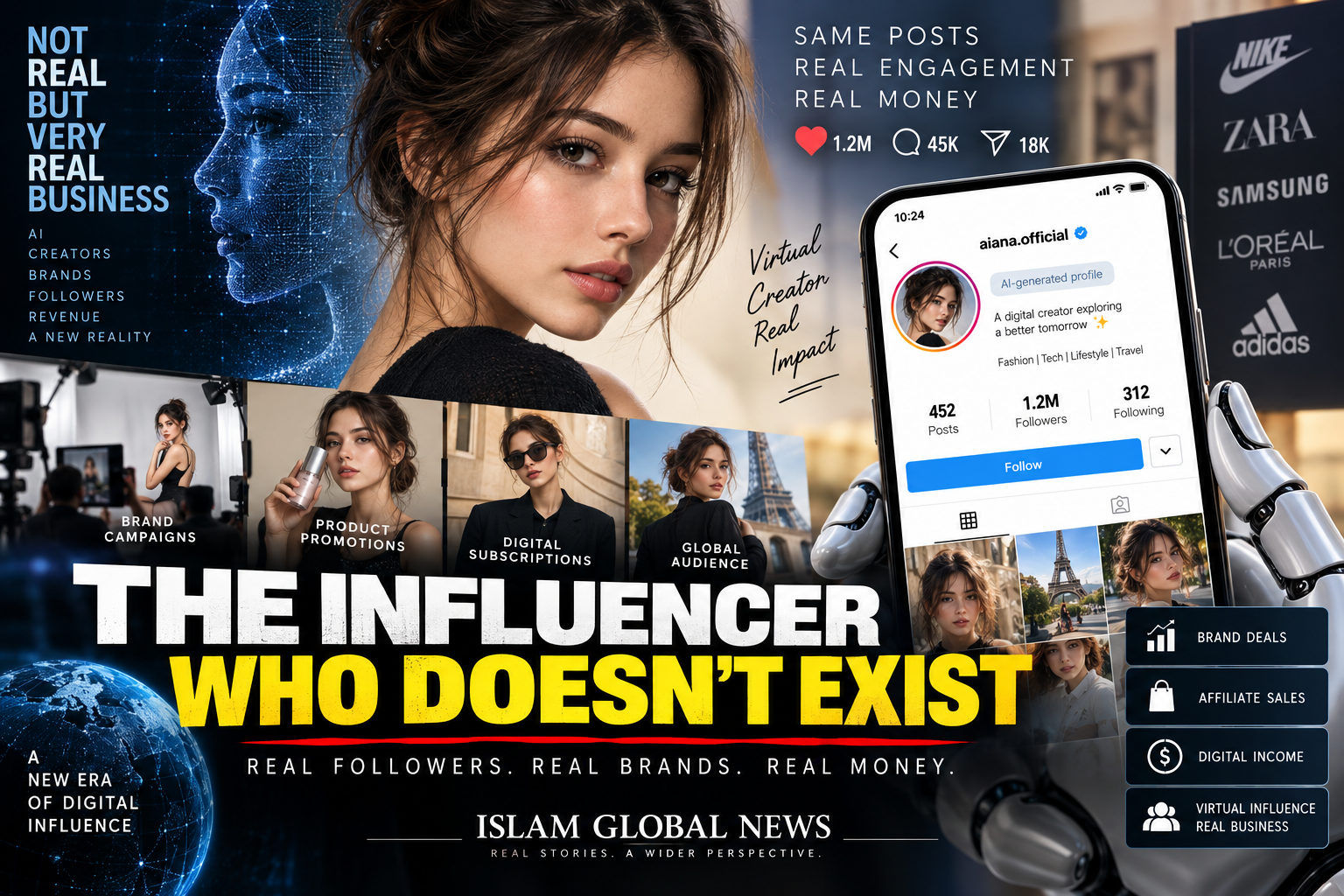
The Influencer Who Doesn't Exist: How AI-Generated People Are Becoming a New Digital Business A new kind of influencer is quietly emerging across social media — and unlike traditional creators, some of these digital personalities do not exist as real people. Artificial intelligence can now generate highly realistic faces, photographs, videos and personalities that can be used to build social-media accounts and attract genuine audiences. Behind these virtual identities are real creators, technology companies and marketing teams looking at a new way to turn digital attention into commercial value. The development is creating a surprising new business question: if the person on the screen is completely artificial, can the influencer still become a real business? AI-generated influencers are already being explored for advertising, entertainment, fashion, beauty, technology and other consumer industries. Instead of arranging a traditional photoshoot with a human model, companies can create or work with a digital personality that can appear in different environments, clothing and promotional campaigns. The attraction for businesses is not difficult to understand. A virtual personality can potentially be managed from anywhere, produce large amounts of visual content and be adapted for different campaigns without the logistical requirements associated with a physical person. But the real business opportunity goes beyond creating attractive AI images. Once a virtual character develops an audience, that audience can become commercially valuable. Brand partnerships, sponsored posts, affiliate marketing, product promotions, subscriptions and licensing are among the possible ways a digital personality can generate revenue. In other words, the artificial person may not be real — but the business surrounding that person can be very real. This is where the emerging AI influencer economy becomes particularly interesting. Traditional influencer marketing depends on a human being building a personal relationship with an audience. Followers watch their videos, listen to their opinions and eventually become potential customers for the brands they promote. AI influencers can follow a similar formula without requiring a conventional human creator to appear in every piece of content. A company could potentially operate several different virtual personalities, each designed for a different audience. One could focus on fashion, another on technology, another on travel, while another could be created specifically for a particular language or market. The ability to create highly targeted digital personalities could eventually change how companies think about online advertising. India is also becoming part of this experiment. The country's creator economy has expanded rapidly, and brands are already using social-media personalities to reach younger consumers. As generative AI becomes more accessible, virtual influencers are creating another option for companies looking to experiment with digital marketing. However, the technology also introduces a major problem that cannot be solved simply by creating better images. Trust. When people see a realistic face on Instagram, TikTok or another social platform, they may naturally assume that the person is real. If an AI-generated personality is presented without proper disclosure, followers may not know whether they are interacting with a real individual or a commercially operated artificial character. That distinction becomes even more important when money is involved. A follower may purchase a product because they believe a recommendation comes from a genuine person. A user may subscribe to content without realising that the personality they are following is entirely computer-generated. This is why transparency is becoming an increasingly important part of the AI influencer business. Social-media companies are beginning to introduce clearer labels and policies around AI-generated profiles and content. The goal is to give users a better understanding of what they are actually seeing on their screens. The rise of AI influencers does not necessarily mean human creators are about to disappear. Human influencers still offer something that artificial personalities cannot easily reproduce: genuine life experiences, physical presence, personal history and direct human connection. For many brands, that authenticity remains extremely valuable. Instead, AI influencers may become another layer of the creator economy — one that exists alongside human creators rather than immediately replacing them. The bigger question is how far this new model can go. If a fictional digital personality can attract millions of real followers, generate advertising revenue and influence purchasing decisions, then the traditional definition of an influencer begins to change. The creator does not necessarily need to be a real person anymore. The audience only needs to believe that the digital personality is worth following. And that may be the most important business development of all. The next generation of social media may not simply be about real people creating content for real audiences. It could also be about companies building artificial personalities, growing real communities around them and turning digital identities into valuable commercial brands. The influencer may not exist. But the followers, the advertising money and the business behind the account can all be very real.
TechnologyGlobal
AI Influencers: How Virtual People Are Becoming a New Digital Business
AI-generated influencers are entering the creator economy as brands explore virtual personalities, digital advertising and new ways to make money online
Advertisement
Related Articles
More in Technology
Technology
Rising Interest Rates Challenge Global AI Data Centre Boom
1 min read

Technology
AI Data Centers Could Cost $30 Trillion, But Here's the Proof It Works
3 min read

Technology
Saudi Arabia Designates 2026 as the Year of Artificial Intelligence
2 min read

Technology
China’s Technology Revolution: Innovation, Growth, and Global Impact
5 min read