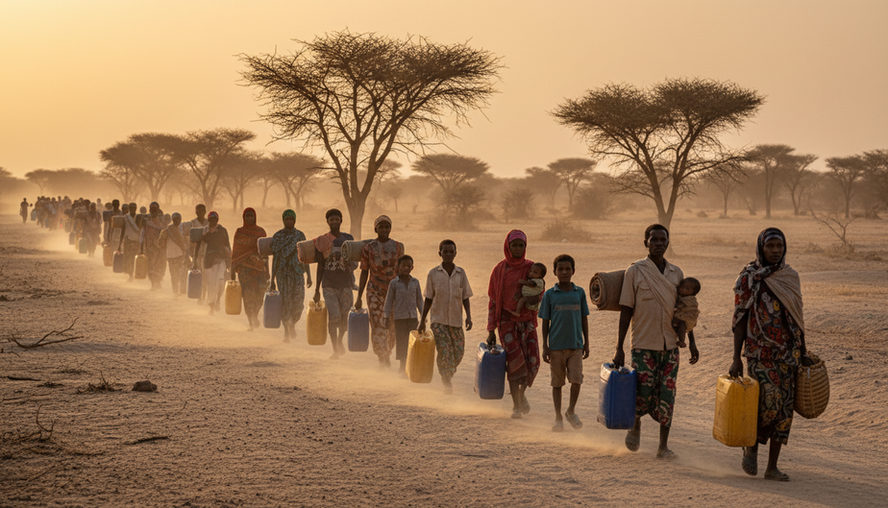
Sudan's war has become one of the world's gravest emergencies, yet it still struggles for sustained global attention. What began in April 2023 as a power struggle between two armed forces has spread across cities, farming regions, borderlands, and displacement routes. By 2026, the conflict remains dangerous because the military balance has not produced a clear winner, outside support has helped prolong the fighting, and civilians are paying the highest price. The war is mainly between the Sudanese Armed Forces, often called the SAF, and the Rapid Support Forces, known as the RSF. Their rivalry grew out of Sudan's troubled transition after the fall of longtime ruler Omar al-Bashir in 2019. A planned move towards civilian rule stalled as security leaders fought over power, command structures, and control of state resources. The result has been a national collapse. Khartoum, once the political and economic centre of Sudan, has seen heavy fighting. Darfur has faced a new wave of ethnic violence and mass displacement. Aid agencies, including UN OCHA, the World Food Programme, UNICEF, the World Health Organization, and the International Organization for Migration, have warned since 2023 that Sudan is facing extreme hunger, disease risks, and one of the world's largest displacement crises.
Why Sudan's war is still escalating in 2026
The conflict has lasted because neither the SAF nor the RSF has been able to secure decisive national control. Each side has strengths that make a quick defeat unlikely.
The SAF retains the formal status of Sudan's national army. It has air power, parts of the state bureaucracy, and recognition from some diplomatic actors. The RSF, which evolved from the Janjaweed militias linked to earlier violence in Darfur, has mobile ground forces and deep networks in parts of western Sudan and urban areas.
That mix creates a brutal pattern. The SAF can strike from the air and hold strategic military sites. The RSF can spread through neighbourhoods, roads, and towns. Civilians then face shelling, street fighting, looting, checkpoints, and forced movement.
Several factors keep the war alive:
Fragmented control
Sudan is too large and politically divided for either side to dominate quickly. Control can shift by
district, road, or town.
Armed allies and local militias
Both sides have relied on local armed groups in some areas. This makes the conflict harder to stop because many actors now have their own grievances and interests.
Economic incentives
Sudan has gold, trade routes, livestock corridors, and cross-border markets. Armed control over these resources can fund continued fighting.
Weak ceasefire enforcement
Several ceasefire efforts since 2023 failed or broke down quickly. Without monitoring, accountability, and real pressure on supply lines, pauses in fighting have often become temporary.
This is why the phrase Sudan Crisis 2026 Sudan Humanitarian Crisis Sudan War 2026 SAF vs RSF Sudan Conflict Khartoum Fighting Darfur Crisis Sudan News Africa Civil War Millions Displaced in Sudan captures the scale of the emergency, even if it reads like a list of separate crises. In reality, these are connected parts of one national breakdown.
Khartoum shows how urban war destroys a country
Khartoum is not just another battlefield. It is Sudan's capital region, home to ministries, hospitals, markets, universities, banks, and transport links. When war reached Khartoum in April 2023, it damaged the systems that hold a country together.
Urban war is especially destructive because fighters operate near civilians and vital services. In Khartoum and nearby Omdurman and Bahri, residents have faced power cuts, water shortages, food scarcity, and the collapse of health care in many areas. Hospitals were damaged, occupied, or forced to close. Medical staff fled or worked under extreme risk.
The fighting also shattered Sudan's economy. Banks, ports, roads, warehouses, and markets are tied to the capital's systems. When those systems fail, shortages spread far beyond the front line. Farmers cannot easily sell crops. Families cannot access savings. Traders face checkpoints and insecurity. Aid groups struggle to move supplies.