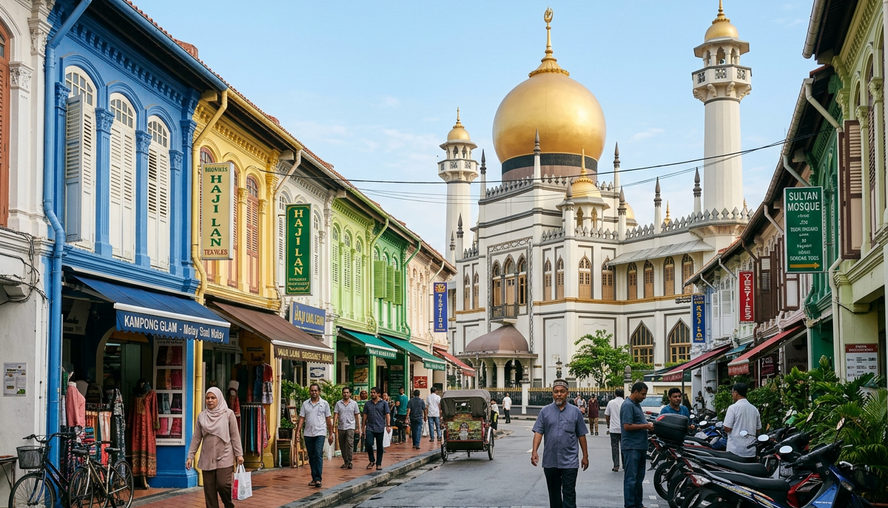
Islam in Singapore is not new. It has been woven into the island's story for centuries through
Malay communities, trade routes, migration, scholarship, food, and family life. What is changing today is the way Islam is growing in Singapore, not only in numbers, but in visibility, organisation, confidence, and everyday influence.
Singapore remains a multi-religious country where Buddhism, Christianity, Islam, Hinduism, Taoism, and other traditions live close together. Within that setting, Muslim life has become more structured, more digitally connected, and more visible in public culture. The growth is careful, community-led, and shaped by Singapore's strong emphasis on harmony
Islam has deep roots in Singapore To understand current growth, it helps to start with history. Islam has long been associated with the Malay world, and Singapore sits within that wider cultural and religious region. Malay Muslims have played a central role in shaping the country's religious identity, language, culture, and community institutions. Mosques in older districts such as Kampong Glam, Geylang Serai, and Tanjong Pagar reflect this long presence. They are not only places of prayer. They also carry memory, family history, and neighbourhood identity. The Muslim community in Singapore includes Malays, Indians, Arabs, Pakistanis, Bangladeshis, Indonesians, Chinese Muslims, converts, and expatriates from many parts of the world. That diversity has made Islamic practice in Singapore broad and layered. Friday sermons, religious classes, festive gatherings, halal food culture, weddings, and charity initiatives all reflect this mix. So when people ask whether Islam is "growing", the answer is more complex than simple population growth. The faith is growing through stronger institutions, wider public presence, better education, and deeper community engagement. Population growth is steady rather than dramatic Singapore's Muslim population has remained a significant minority for decades. Public census data have generally shown Muslims forming a stable share of the resident population, led mainly by the Malay community, with smaller groups from other ethnic backgrounds. This means Islam's growth in Singapore is not best understood as a sudden demographic surge. Singapore has low birth rates across communities, strict immigration systems, and a highly regulated social environment. Religious change tends to happen slowly. The more visible growth appears in other areas: More organised Islamic learning for children, youth, and adults Greater demand for halal food and Muslim-friendly services More public discussion around modest fashion, religious identity, and inclusion Stronger online access to religious talks and classes Continued development of mosques as community centres This kind of growth may not always show up sharply in population charts, but it affects daily life in clear ways. Mosques have become stronger community spaces Mosques in Singapore do much more than host daily prayers. Many serve as local support hubs where people attend classes, seek guidance, volunteer, donate, and connect with others. The Islamic Religious Council of Singapore, known as MUIS, plays a key role in organising Muslim religious life. It supports mosque development, halal certification, religious education, zakat collection, and community programmes. This central structure gives the Muslim community a formal channel to respond to social needs while working within Singapore's national framework. In many neighbourhoods, mosques run activities such as: Quran reading classes
Marriage preparation courses
Youth mentoring
Charity distribution
Ramadan programmes
Talks on family, ethics, and mental well-being
Interfaith visits and outreach
This has helped Islam remain relevant for younger generations. A mosque is not only a place to attend on Fridays or during Ramadan. For many families, it offers a rhythm of learning, service, and belonging.
Islamic education is adapting to modern life
Religious education is another major part of Islam's growth in Singapore. Traditional madrasahs continue to serve students who pursue Islamic and academic studies together. At the same time, weekend classes, mosque-based lessons, online lectures, and short courses have made Islamic learning more accessible to working adults and school-going children.
This shift matters. Singaporean Muslims live in a fast-moving, highly educated society. Many want religious guidance that speaks to modern questions, including career choices, finance, marriage, social media use, parenting, and interfaith friendships.
Good Islamic education in Singapore often focuses on balance. It teaches faith and civic responsibility. It encourages religious confidence, while respecting the country's multi-religious setting.
That balance is one reason the Muslim community has remained integrated into national life. Growth here does not usually mean separation from wider society. It often means finding ways to be visibly Muslim and fully Singaporean at the same time.
Halal culture has moved into the mainstream One of the clearest signs of Islam's public influence is halal food. In Singapore, halal dining is not limited to Malay or Indian Muslim food. It now includes cafes, bakeries, fast-food outlets, hotel buffets, Japanese food, Korean-style meals, and local hawker favourites. This growth reflects both religious need and commercial demand. Muslim consumers look for trustworthy halal options, while many non-Muslims also enjoy halal-certified eateries with friends, colleagues, and family members. In a country where eating together is part of social life, halal access supports inclusion. Halal certification also adds trust. It gives Muslim consumers confidence that ingredients and preparation meet standards. In Singapore's food culture, that matters. The halal economy also extends beyond restaurants. It touches travel, cosmetics, personal care, modest fashion, and festive retail during Ramadan and Hari Raya. These markets show how religious practice can shape everyday consumer choices without losing its spiritual centre. Converts and younger Muslims are shaping new conversations Another quiet area of growth comes from converts, often called reverts in some Muslim communities. Singapore has local organisations and mosque programmes that support people learning about Islam, including those who embrace the faith as adults. Converts bring new questions into the community. They may need help with prayer, family conversations, religious terms, food practices, and social adjustment. Their presence encourages Muslim institutions to explain Islam in clearer and more welcoming ways. Younger Muslims are also shaping the conversation. Many are educated, multilingual, and active online. They engage with scholars, podcasts, short videos, and global Muslim discussions. At the same time, they live in a uniquely Singaporean context, where social harmony and respect for law are central. This creates a distinct Muslim identity, rooted in faith but aware of pluralism. Many young Muslims want to practise Islam with sincerity while contributing to national life in medicine, education, public service, entrepreneurship, the arts, and community work. Interfaith life shapes Singapore's Muslim experience Singapore's religious environment is close-knit. Mosques, temples, churches, and other places of worship often sit near one another. People of different beliefs study, work, and live together in the same HDB blocks. This closeness influences how Islam grows. Muslim leaders often take part in interfaith efforts: community dialogues and national events. The aim is not to dilute religious identity, but to build trust. Singapore's approach to religion places strong value on public order and mutual respect. That has shaped a form of Muslim community life that is organised, cautious in public messaging, and conscious of the wider society. For Singaporean Muslims, growth therefore carries a dual responsibility: to strengthen faith within the community and to maintain good relations beyond it. The real story is influence, not just numbers
Islam's growth in Singapore shows up in daily patterns. More halal choices. More structured mosque programmes. More visible Muslim identity. More access to religious learning. More young people asking serious questions about faith. More institutions helping the community serve others. This is not a story of rapid expansion or social division. It is a story of steady presence in a modern city-state, where religion must be both meaningful and responsible. Islam's future in Singapore will likely continue along this path: grounded in tradition, shaped by education, supported by institutions, and expressed through ordinary acts of prayer, charity, family life, and neighbourly respect. That quiet growth may be its most important strength.