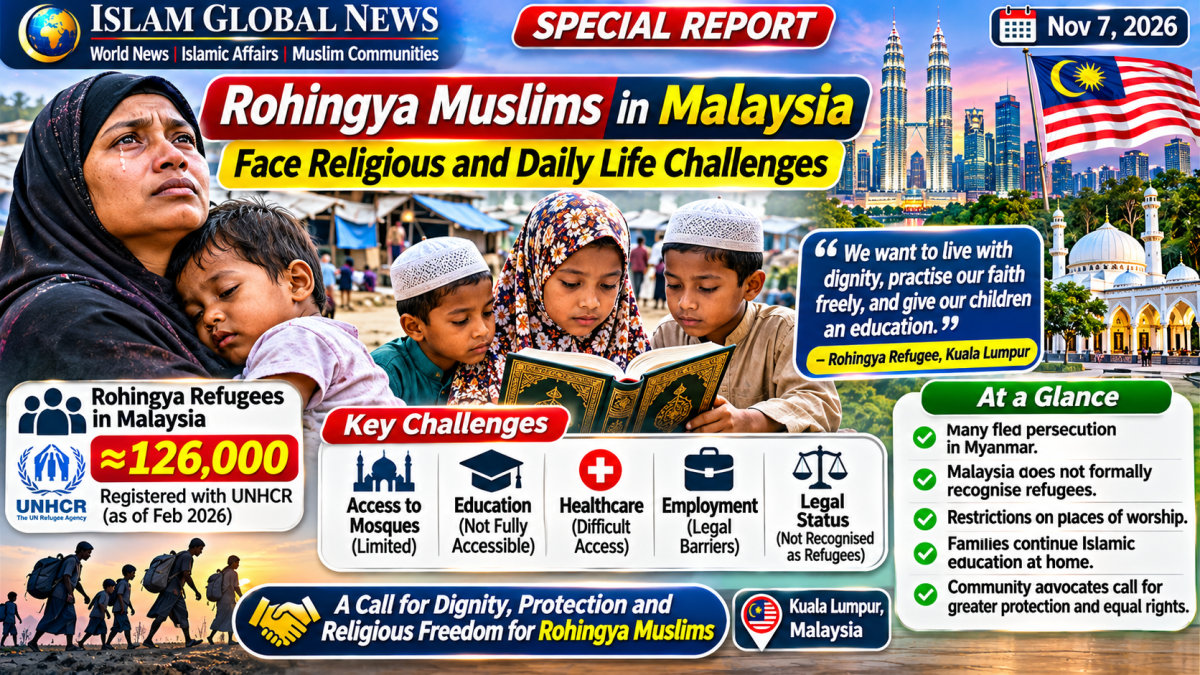
Rohingya Muslims in Malaysia Face Challenges Practising Their Faith Despite Shared Religion KUALA LUMPUR, Malaysia — November 7, 2026 Thousands of Rohingya Muslim refugees living in Malaysia continue to face difficulties accessing education, healthcare, employment and religious spaces, despite seeking refuge in a Muslim-majority country. According to the United Nations refugee agency (UNHCR), approximately 126,000 Rohingya refugees were registered in Malaysia as of February 2026. Many fled Myanmar following years of persecution and violence, particularly during the 2017 military crackdown that forced hundreds of thousands of Rohingya across the border into Bangladesh and other countries. Religious freedom remains a challenge Although Malaysia has a large Muslim population, it does not formally recognise refugees under its national legal framework. This leaves many Rohingya vulnerable to immigration detention and limits their access to essential services. The religious challenges extend beyond legal status. Some Rohingya refugees reportedly experience discrimination when attempting to attend local mosques. Others avoid communal prayers for fear of encountering immigration enforcement officers. The religious freedom organisation Christian Solidarity Worldwide (CSW) told the Associated Press that Rohingya refugees cannot officially register their own places of worship in Malaysia. Families struggle to preserve Islamic education For many displaced families, maintaining their children's Islamic education has become central to preserving their identity. Zahidah Begum, a Rohingya refugee living in Kuala Lumpur, teaches her daughters Quranic verses, prayers and Islamic values at home. Her father was an Islamic teacher in Myanmar who taught religious studies in their village. After fleeing persecution, he died in Bangladesh without receiving adequate medical treatment, according to her account. She continues his educational legacy by teaching her children. Separation, poverty and uncertainty Other refugees face severe economic and emotional difficulties. Some struggle to find stable employment, afford medical treatment and reunite with family members who remain in Bangladesh or elsewhere. The absence of formal refugee recognition also creates obstacles for children seeking access to regular education. Rohingya community advocates are calling for improved protection, fair wages, healthcare access, educational opportunities and greater freedom to practise their religion. A call for dignity and inclusion The experiences of Rohingya refugees in Malaysia highlight the challenges faced by displaced communities even after reaching countries where they share religious and cultural connections. For many families, the struggle is not only about finding shelter and employment, but also about preserving their faith, educating their children and rebuilding a sense of belonging. Islam Global News Editorial Desk will continue to follow developments affecting Rohingya communities and Muslim refugees across the world.
🇲🇾 MalaysiaMalaysia
Rohingya Muslims in Malaysia Face Religious Challenges
Rohingya refugees in Malaysia face challenges accessing mosques, education, healthcare and employment despite living in a Muslim-majority country.
What do you think about this story?
Your opinion matters to us!
No account required. Comments are private and never published.
Advertisement