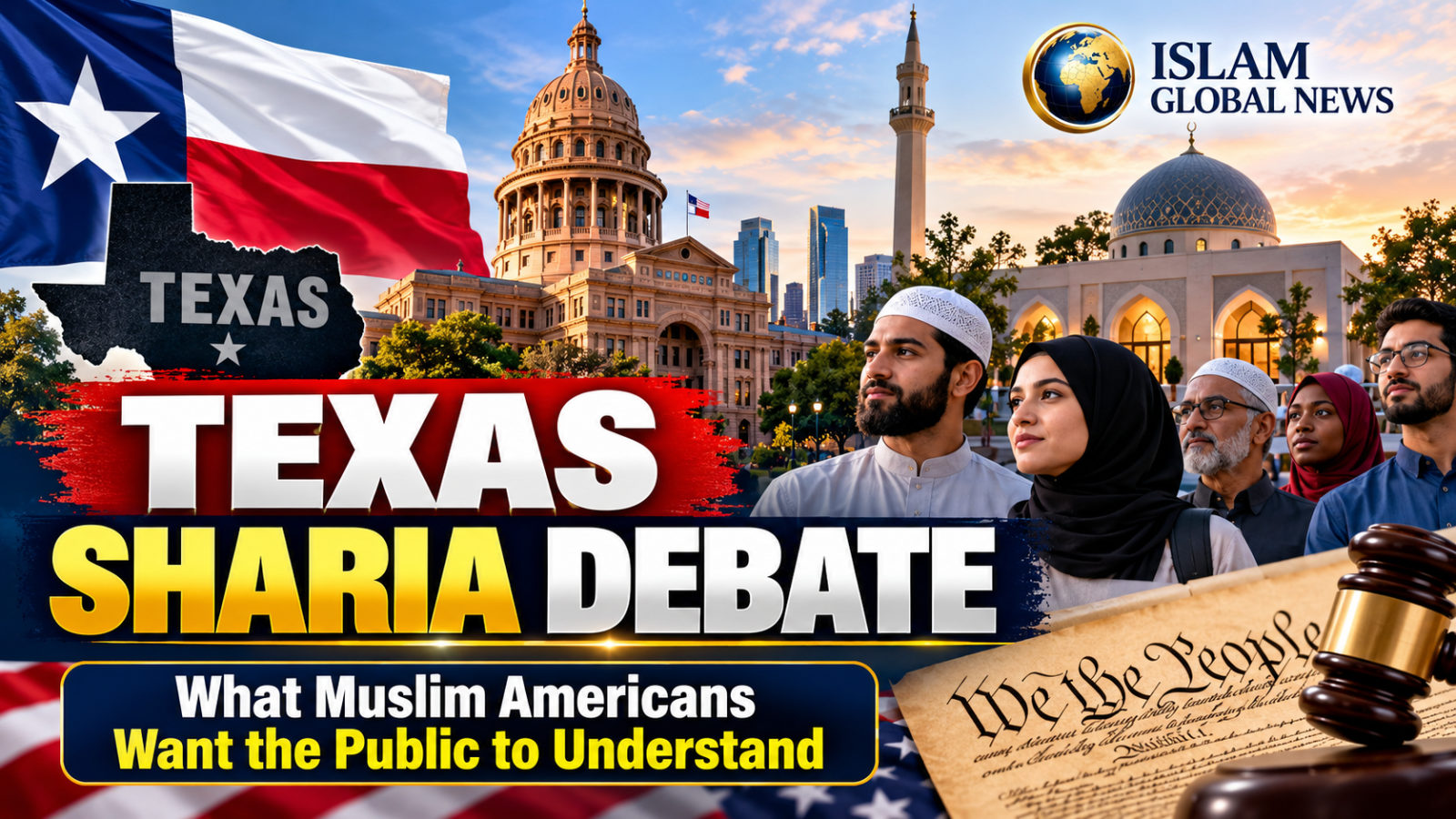
Texas Sharia Debate: What Muslim Americans Want the Public to Understand
TEXAS, UNITED STATES — A growing political debate over Sharia law in Texas has brought renewed attention to how Islam is understood in American public life, with Muslim residents and Islamic scholars challenging what they describe as misleading portrayals of their faith.
The debate is not simply about religious terminology. It also raises broader questions about religious freedom, constitutional protections and how minority communities are represented in political discussions.
In a report published on August 31, 2026, The Texas Tribune examined how Muslim Texans are responding to political criticism of Sharia and explaining what the concept means in their religious lives.
What Does Sharia Mean in Islam?
Sharia is often described in political debates as a single legal system. However, Islamic scholars explain that the concept has a broader and more complex meaning.
It can refer to religious and ethical principles that guide a Muslim’s relationship with God and other people. These include prayer, charity, honesty, personal conduct and responsibilities toward family and neighbours.
Islamic jurisprudence has developed over centuries, producing different schools of thought and interpretations. As a result, Sharia should not automatically be understood as one uniform set of laws applied identically by all Muslims.
The distinction between personal religious practice and state-enforced legal rules is central to understanding the current controversy.
Why Is Texas Debating Sharia?
According to The Texas Tribune, Texas Republican politicians have intensified their criticism of Sharia, arguing that certain interpretations could conflict with American constitutional principles and individual rights.
The report described political proposals calling for restrictions on the promotion or implementation of Sharia. It also documented concerns among Muslim Texans that broad political statements about Islamic law risk portraying an entire religious community through the actions or beliefs of particular groups.
The debate has extended beyond legal questions to discussions involving Muslim religious practices, Islamic institutions and the visibility of Muslims in public life.
However, political proposals, party-platform positions and enacted laws are not the same thing. The status of any specific measure must be verified through official legislative records before it is described as law.
Muslim Texans Respond to Public Misunderstandings
Muslim residents quoted in the report said that their everyday religious lives often focus on worship, good character, family responsibilities, charity and treating others fairly.
For many Muslims, religious practice does not mean seeking to impose their beliefs on people of other faiths.
Islamic scholars interviewed by the newspaper also emphasised that the meaning and interpretation of Sharia have varied across different historical periods and scholarly traditions.
These explanations do not mean that every law adopted in the name of religion is beyond criticism. Rather, they highlight the importance of examining specific policies and practices instead of assuming that all Muslims share one political or legal agenda.
Religious Freedom and the American Constitution
The debate also raises questions about the relationship between religious freedom and the rule of law in the United States.
The First Amendment protects the free exercise of religion while prohibiting the government from establishing an official religion. These protections form an important part of the constitutional framework governing religious life in America.
Religious freedom does not exempt anyone from generally applicable laws. At the same time, belonging to a minority religion does not, by itself, establish that a person intends to undermine the Constitution.
For Muslim Americans, the challenge is to practise their faith while participating in a society where religious identity can become a subject of political controversy.
Why This Debate Matters Beyond Texas
Texas is home to Muslim communities with diverse ethnic, cultural and national backgrounds. The Texas Tribune report cited estimates placing the Muslim population in the state at approximately 300,000 to 500,000 people.
The discussion has significance beyond Texas because it illustrates how religious concepts can become political symbols in debates about national identity, immigration, constitutional rights and cultural differences.
For readers seeking to understand Islam, a key distinction is the difference between the beliefs of ordinary Muslim communities, the interpretations of Islamic scholars and the policies adopted by governments or political movements.
Treating these as separate questions allows for a more informed discussion—one that recognises legitimate debates about law and individual rights without making unsupported generalisations about an entire faith community.
The Bigger Picture
The Texas Sharia debate highlights the importance of accurate information when religion becomes part of political campaigning.
Understanding Sharia requires attention to Islamic history, different scholarly interpretations and the distinction between personal religious observance and government policy.
For Muslim Americans, the issue also concerns whether their religious beliefs can be discussed fairly without their community being treated as a single political group.
As the debate continues, the practical impact will depend on the specific proposals introduced, the laws ultimately adopted and how constitutional protections are applied.
Islam Global News will continue to follow developments affecting Muslim communities, religious freedom and public policy in the United States.
Source: The Texas Tribune, “Muslims push back as Texas Republicans sharpen attacks on sharia law,” August 31, 2026.