Islam in China is not new. It has been part of Chinese society for more than a thousand years. What has changed is its visibility among some groups, especially in cities, universities, trade hubs, and online religious spaces.
Exact numbers are hard to prove. China's national census does not ask detailed religion questions. Estimates often place the Muslim population at around 20 million to 30 million, including Hui, Uyghur, Kazakh, Kyrgyz, Dongxiang, Salar, and other communities. The Pew Research Center has described China as home to one of the world's larger Muslim populations, even if Muslims remain a small share of the national
population.
So the better question is not whether Islam is "suddenly" growing everywhere in China. It is more precise to ask why Islam is gaining attention, why some Chinese people are converting, and how this affects society.
Islam has deep roots in Chinese history
Islam reached China through trade, migration, and diplomacy. Muslim merchants travelled along the Silk Road and maritime routes from Central Asia, Persia, Arabia, and South Asia. Over centuries, Muslim communities settled in places such as Xi'an, Yunnan, Ningxia, Gansu, Qinghai, and Xinjiang.
The Hui are one of the best-known Muslim groups in China. Many speak Mandarin as their first language and have long lived among Han Chinese communities. Uyghurs, Kazakhs, and Kyrgyz Muslims in western China have closer linguistic and cultural ties to Central Asia.
This long history matters. It challenges the idea that Islam is foreign to China. Chinese Muslim identity has often mixed Islamic belief with Chinese language, food traditions, architecture, and family life.
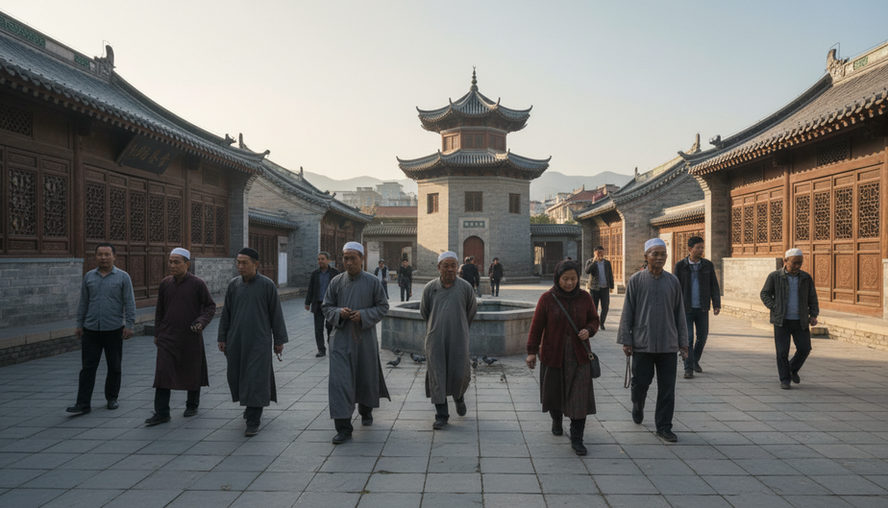
A mosque in Xi'an, for example, can look different from one in Istanbul or Delhi. It may use Chinese-style roofs and courtyards while still serving the same purpose: prayer, learning, and community.
Why more Chinese people are encountering Islam
Several forces have made Islam more visible in parts of China. These forces do not affect every region in the same way. They also do not erase the strict controls placed on religious life. Still, they help explain the trend.
Cultural exchange has widened religious contact
China's links with Muslim-majority regions have grown through travel, education, trade, and migration. Students from countries such as Pakistan, Indonesia, Malaysia, Egypt, and Saudi Arabia have studied in Chinese universities. Chinese students and businesspeople have also spent time in Muslim-majority countries.
These contacts often begin in ordinary ways:
sharing meals at university canteens
asking why a classmate fasts during Ramadan
visiting a mosque out of curiosity
learning Arabic for study or trade
watching religious lectures online
Food is one of the most common entry points. Halal food is widely recognised in many Chinese cities. Lanzhou beef noodles, associated with Hui Muslim food culture, are known across China. A halal restaurant can become more than a place to eat. It can become a place where non-Muslims ask questions about faith, discipline, and community.
One convert story often follows this pattern. A Han Chinese university student meets Muslim classmates. At first, Islam means dietary rules and prayer times. Later, the student asks deeper questions about purpose, family, and self-control.
Not every conversation leads to conversion. Most do not. Yet repeated contact lowers fear and builds familiarity.
Trade has created practical links with Muslim communities
Economic opportunity also plays a role. China trades heavily with Muslim-majority countries across Asia, the Middle East, and Africa. The Belt and Road Initiative increased public discussion of trade corridors that pass through Central Asia, Pakistan, the Gulf, and beyond.
This has practical effects. Some Chinese traders learn basic Arabic. Some adjust their products for halal markets. Some spend long periods in cities such as Dubai, Kuala Lumpur, Jakarta, or Karachi. Over time, business contact can become cultural contact.
Yiwu, a major trading city in Zhejiang province, is one example often discussed by scholars and journalists. It has attracted merchants from the Middle East, South Asia, and Africa. Such places expose local Chinese residents to Muslim practices in daily life, not just through news reports.
Economic ties do not automatically produce religious conversion. Many people engage with Muslim partners only through commerce. Yet trade creates human relationships. Trust, hospitality, and shared routines can change perceptions.
Social dynamics give conversion a personal meaning
For new converts, Islam can offer a framework for daily life. Converts often describe attraction to prayer, regular discipline, modest living, care for parents, and the idea of one God.
Some also describe a search for moral certainty. China's rapid urbanisation has changed family structures, work patterns, and social expectations. People who move from small towns to large cities can feel isolated. Religious communities can provide belonging.
This does not mean converts reject Chinese culture. Many see Islam as a way to live more responsibly within family and society. Hui Muslim communities often show that Chinese identity and Islamic identity can coexist.
At the same time, conversion can create tension. Family members may worry about diet, marriage, burial customs, or state attitudes towards religion. A convert may face questions such as:
Will you still join family ancestor rituals?
Can you eat with us during festivals?
Will you marry outside the family's expectations?
Are you joining a foreign religion?
These questions are personal. They also reflect larger debates about religion, identity, and national culture.
Stories from new converts show the human side
The following accounts are anonymised composite stories based on themes commonly found in publicly reported interviews, academic writing, and convert narratives. They are not presented as direct quotes from named individuals.
Li Wei found Islam through language study
Li Wei, a Han Chinese student from eastern China, began learning Arabic for career reasons. He wanted to work in international trade. His first contact with Islam came through grammar lessons, Qur'anic phrases, and conversations with classmates from Muslim-majority countries.
He later visited a mosque with a Hui friend. What surprised him was not the building. It was the routine.
"I saw people stop what they were doing and pray. It felt serious, but also calm. I had never seen faith organised into daily time like that."