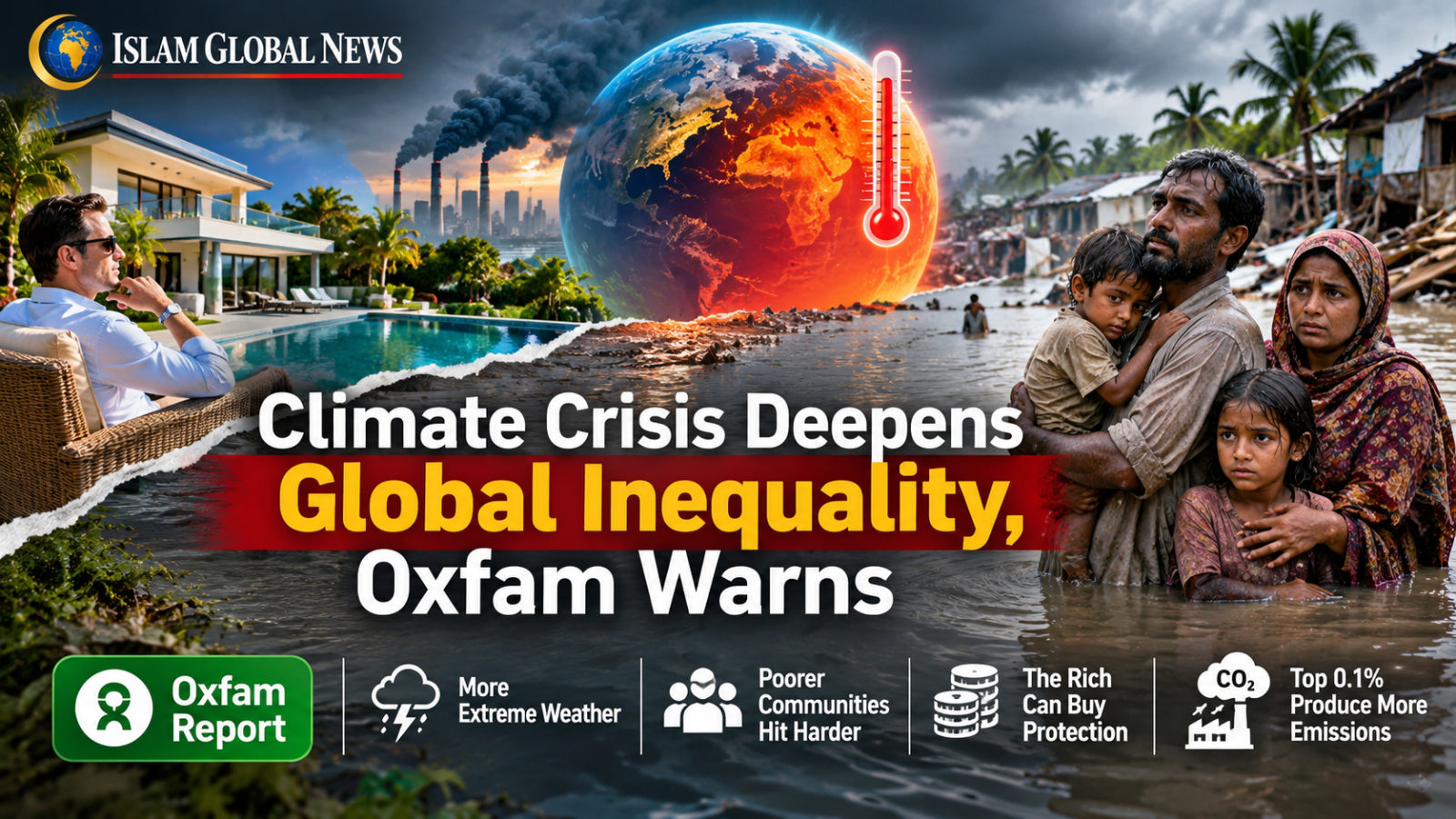
Climate Crisis Deepens Global Inequality as the Rich Buy Protection, Oxfam Report Warns By Islam Global News Editorial Desk Published: 6 November 2026 Category: Environment & Climate | Global Affairs The growing climate crisis is widening the gap between rich and poor, with wealthy populations better positioned to protect themselves from extreme weather while vulnerable communities face greater risks of losing their homes, livelihoods and savings, according to a new report by Oxfam International. The report, titled Disaster Divide: How Climate Chaos Deepens Inequality and Enriches the Few, examines how climate-related disasters affect people differently depending on their financial resources and exposure to environmental risks. Oxfam's analysis finds that the world's richest 0.1 per cent — approximately eight million people — produce more carbon pollution than the poorest 3.5 billion people combined. The organisation also estimates that the emissions of the richest one per cent are responsible for around 20 per cent of global warming since 1990. These findings highlight the unequal relationship between responsibility for climate pollution and exposure to its consequences. Wealth can provide protection from climate disasters People with substantial financial resources can often reduce their exposure to climate-related dangers by purchasing homes in safer locations, obtaining insurance, arranging alternative accommodation and accessing private emergency services. For low-income households, the same options may be financially out of reach. A severe flood, wildfire, drought or heatwave can destroy a family's home, damage agricultural land, interrupt employment and eliminate savings. When several disasters occur within a short period, families may struggle to recover and become increasingly dependent on loans or humanitarian assistance. Oxfam describes this cycle as a disaster divide, in which existing economic inequality increases vulnerability and climate disasters further deepen poverty. South Asia faces serious inequality risks The report highlights Nepal as an example of how countries with relatively low greenhouse gas emissions can experience serious climate impacts. According to Oxfam's account, Nepal contributes less than 0.1 per cent of global greenhouse gas emissions but faces threats including glacier-related flooding, extreme heat and landslides. Across vulnerable regions, the consequences can extend beyond immediate property damage. Agricultural production, food prices, access to clean water, public health and local employment can all be affected. For communities already experiencing economic hardship, these impacts can make recovery particularly difficult. Oxfam calls for stronger climate accountability Oxfam argues that reducing greenhouse gas emissions alone will not address the unequal effects of climate change. The organisation is calling for governments to make major polluters contribute more towards climate action, strengthen climate adaptation funding and ensure that disaster-recovery programmes reach vulnerable communities. Its recommendations include stronger taxation of extreme wealth and high-polluting activities, improved regulation of companies, and increased international climate finance. The report also argues that climate assistance should avoid adding further debt burdens to countries already struggling with climate-related losses. Why this matters to ordinary people Climate change is not only an environmental issue. It can influence household expenses, food security, insurance costs, employment, housing and migration. When floods destroy farms or extreme heat reduces working hours, the economic consequences can reach far beyond the affected location. Poorer households generally have fewer financial resources to absorb these shocks. The central question raised by the report is therefore not only how much the world spends on climate protection, but also whether that protection reaches the people most exposed to climate disasters. As governments prepare for international climate discussions, the challenge will be to combine emissions reductions with fairer access to protection, recovery funding and essential services. Islam Global News Editorial Desk Sources and References 1. Oxfam International — Disaster Divide report and research findings, published 27 October 2026. 2. Oxfam GB — Climate chaos deepens inequality and makes the richest richer, 27 October 2026. 3. Inter Press Service — Wealth Buys Protection in Climate Crisis, 5 November 2026. This article summarises findings and arguments published by Oxfam. The research estimates and policy recommendations are attributed to the organisation and should not be interpreted as independent findings by Islam Global News.
HealthGlobal
Climate Crisis Deepens Global Inequality, Oxfam Warns
Oxfam warns that climate change is deepening global inequality as wealthy populations buy protection while vulnerable communities face growing disaster risks.
What do you think about this story?
Your opinion matters to us!
No account required. Comments are private and never published.
Advertisement