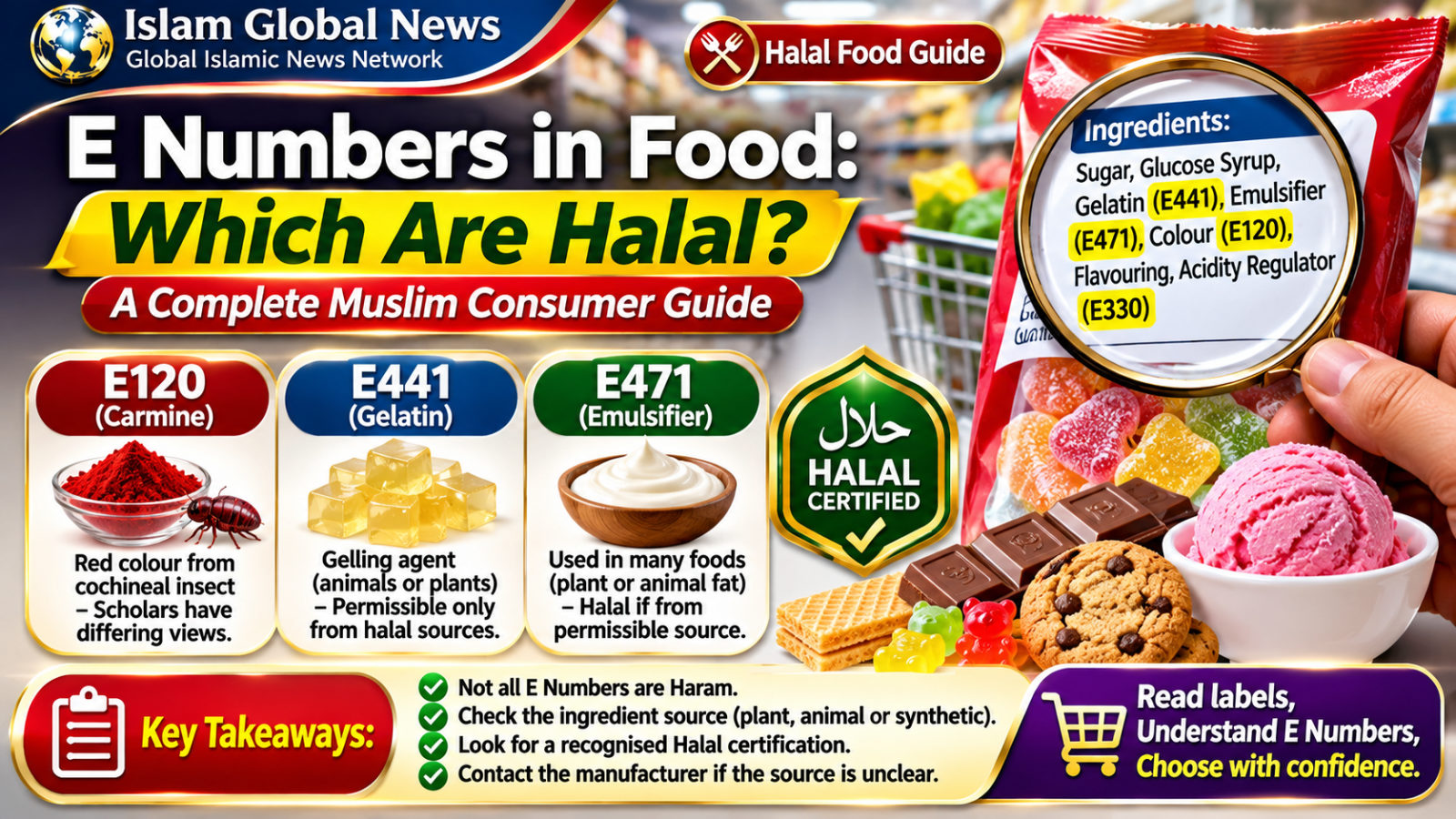
E Numbers in Food: Which Are Halal and Which Should Muslims Check? Islam Global News | Islamic Knowledge Editorial Team Have you ever checked the ingredients on a packet of biscuits, chocolate, sweets or ice cream and noticed codes such as E120, E471 or E441? These codes are known as E Numbers. They identify food additives used to improve colour, taste, texture, freshness and shelf life. For Muslim consumers, an important question arises: Are these additives Halal, Haram or doubtful? The answer is not the same for every E Number. Some additives are made from plants or minerals, while others may come from animals, insects or different manufacturing processes. Understanding their origins can help consumers make more informed food choices. What Are E Numbers? E Numbers are identification codes assigned to food additives authorised for use in the European food regulatory system. Food manufacturers use additives for several purposes: - Food colouring - Preserving freshness - Improving texture - Preventing separation - Enhancing flavour - Maintaining consistency The European Food Safety Authority explains that additives can originate from plants, animals, minerals or chemical synthesis. An E Number identifies an additive; it does not automatically indicate whether it is Halal. Common E Numbers Muslim Consumers Should Know The following examples are particularly useful when checking food labels. 1. E120 – Carmine or Cochineal E120 is a red food colouring obtained from cochineal insects. It may be used in sweets, desserts, drinks and other coloured food products. Halal consideration: Islamic scholars have differing opinions about the permissibility of insect-derived ingredients. Some authorities consider cochineal unsuitable, while others permit it under particular interpretations. Consumers should check the guidance of their trusted Islamic authority. 2. E441 – Gelatin Gelatin is used as a gelling agent in products such as marshmallows, jelly sweets, desserts and capsules. It may be produced from animal skin, bones or connective tissue. Halal consideration: Its status depends on the animal source, slaughter requirements and relevant Islamic rulings. Pork-derived gelatin is not permissible. Gelatin from an appropriately slaughtered permissible animal may be acceptable. Look for verified Halal certification or clear manufacturer information. 3. E471 – Mono- and Diglycerides of Fatty Acids E471 is commonly used as an emulsifier in bakery products, margarine, ice cream, chocolate and processed foods. It can be manufactured using vegetable oils or animal fats. Halal consideration: Plant-derived E471 is generally acceptable. If it comes from animal fat, the animal source and slaughter requirements must be checked. The E-number alone does not reveal its origin. 4. E472 – Esters of Mono- and Diglycerides E472 is a family of food emulsifiers used in products such as bread, cakes and other processed foods. The fatty acids used in their production may have plant or animal origins. Halal consideration: Check the source of the fatty acids and the manufacturer's certification. 5. E422 – Glycerol Glycerol is used as a humectant to help retain moisture in foods, sweets and bakery products. It can be obtained from vegetable oils, animal fats or synthetic processes. Halal consideration: The source and production process should be verified, particularly when the manufacturer does not disclose the origin. 6. E631 – Disodium Inosinate E631 is a flavour enhancer commonly used in savoury snacks, instant noodles, seasonings and processed foods. It can be produced through different manufacturing methods and may have animal or microbial origins. Halal consideration: Ask the manufacturer about the source and production method. Do not assume that every product containing E631 has the same Halal status. 7. E322 – Lecithin Lecithin is an emulsifier commonly used in chocolate, baked goods and confectionery. Common sources include soybeans and egg yolks. Halal consideration: Soy-derived lecithin and lecithin from permissible eggs are generally acceptable. Verify the source if it is not specified. E Numbers That Are Generally Plant or Mineral Based The following additives are commonly produced from plant, microbial or mineral sources: E Number| Additive| Common source E300| Ascorbic acid| Industrial synthesis or fermentation E330| Citric acid| Microbial fermentation E406| Agar| Seaweed E407| Carrageenan| Red seaweed E412| Guar gum| Guar beans E415| Xanthan gum| Microbial fermentation E440| Pectin| Fruit sources E551| Silicon dioxide| Mineral or industrial sources These are generally considered suitable from a source perspective, but the complete formulation and manufacturing process should still be checked where necessary. How Can Muslims Check Whether a Product Is Halal? Before purchasing a packaged food product, consider these practical steps: 1. Read the complete ingredients list. 2. Identify unfamiliar E Numbers. 3. Check whether an additive has an animal, plant, microbial or mineral origin. 4. Look for certification from a recognised Halal certification body. 5. Contact the manufacturer if the ingredient source is unclear. 6. Check whether the certification applies to the exact product and manufacturing facility. A Halal logo should also be verified rather than accepted solely on appearance. Does an E Number Mean a Product Is Haram? No. An E Number is a food additive identification code, not a religious classification. Some additives are generally suitable, some require source verification, and others involve differences of scholarly opinion. For example, E471 can be made from vegetable or animal fats. Therefore, classifying every product containing E471 as Haram would be inaccurate. Similarly, food safety authorisation and Halal certification are two different matters. A food additive may be legally approved for use without that approval establishing its Halal status. Frequently Asked Questions 1. Are all E Numbers Haram? No. Many E Numbers are derived from plants, minerals or microbial processes. Others require additional investigation. 2. Is E471 Halal or Haram? It depends on its source. Vegetable-derived E471 is generally acceptable, while animal-derived E471 requires verification. 3. Is E120 permissible in Islam? There are differing scholarly opinions regarding cochineal. Consumers should follow a recognised religious authority. 4. Is E441 always Haram? No. Gelatin can come from different animal sources. Its permissibility depends on the source, slaughter conditions and relevant Islamic rulings. 5. How can I identify Halal food in a supermarket? Check the ingredients, verify the certification mark and contact the manufacturer when the source of an ingredient is uncertain. Final Word Understanding E Numbers is an important part of making informed food choices. Muslim consumers should not assume that every additive is Haram or that every legally approved additive is automatically Halal. The most reliable approach is to examine the ingredient source, manufacturing process and recognised Halal certification. Islam Global News | Islamic Knowledge Editorial Team Editorial note: This article is for general educational information and is not a personal fatwa. Islamic rulings may differ between recognised scholars and schools of thought.
Halal LifestyleGlobal Worldwide
E Numbers in Food: Halal or Haram?
Learn which E numbers are Halal, Haram or doubtful. Understand E120, E441, E471 and how to check food ingredients.
What do you think about this story?
Your opinion matters to us!
No account required. Comments are private and never published.
Advertisement