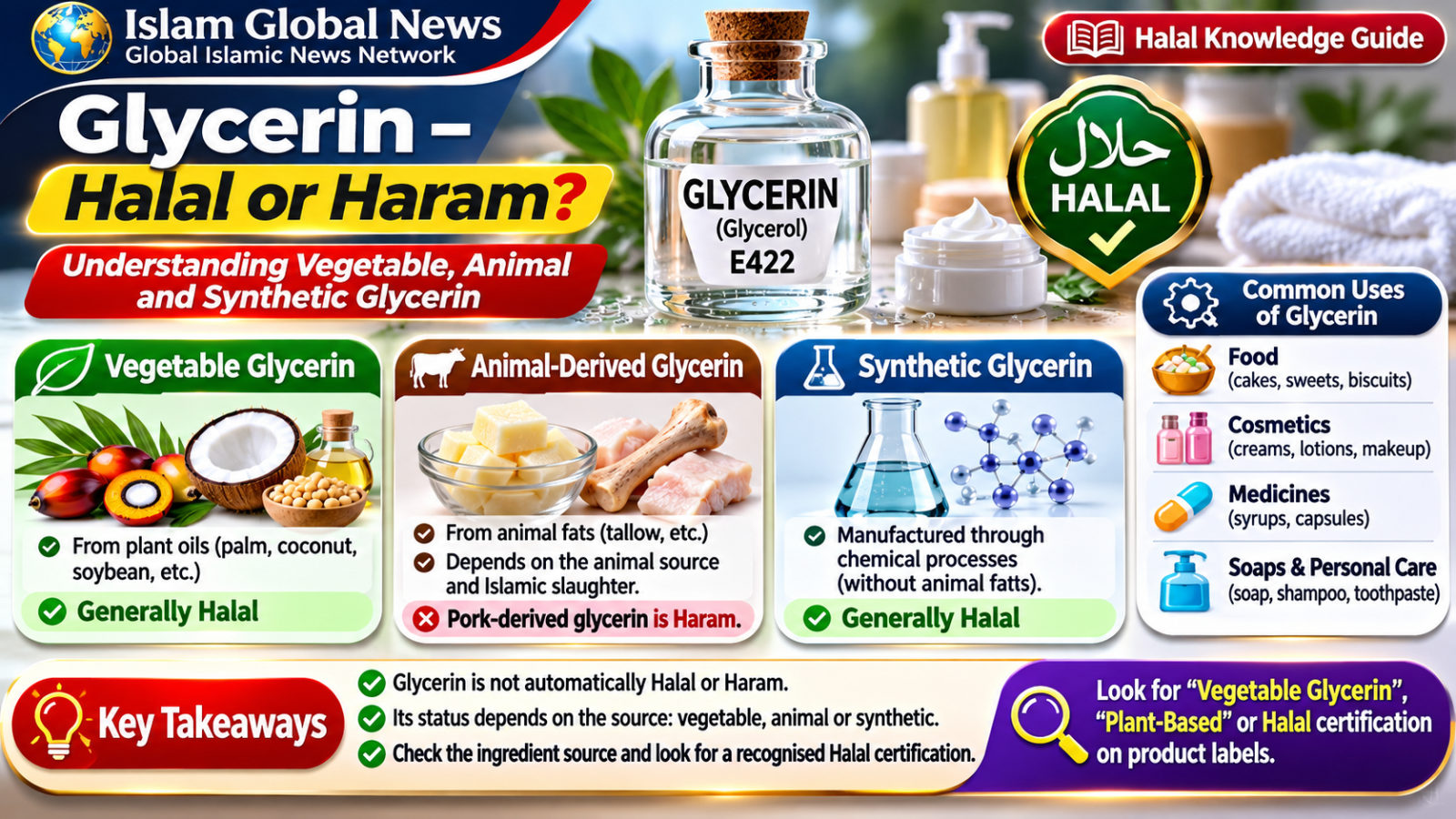
Glycerin – Halal or Haram? Understanding Vegetable, Animal and Synthetic Sources Islam Global News | Islamic Knowledge Editorial Team Glycerin is a common ingredient found in everyday products, including food, toothpaste, soaps, shampoos, moisturisers, cosmetics and medicines. Many Muslim consumers may notice the word Glycerin or Glycerol on a product label and wonder whether it is Halal or Haram. The important point is that glycerin does not have only one source. It can be produced from vegetable oils, animal fats or synthetic chemical processes. Its Islamic status therefore depends on its origin and the applicable Islamic rulings. What Is Glycerin? Glycerin, also known as glycerol, is a clear, colourless and slightly sweet liquid. It is widely used in manufacturing because it attracts and retains moisture. Its common uses include: - Food products: Helps maintain moisture in cakes, sweets and other processed foods. - Cosmetics: Helps prevent creams and lotions from drying out. - Soap: Can help produce softer and more moisturising soap. - Toothpaste: Helps maintain a smooth consistency. - Medicines: Used in certain syrups, creams and pharmaceutical formulations. On food labels, glycerin may appear as E422. 1. Vegetable Glycerin – Generally Halal Vegetable glycerin is obtained from plant-based oils, including palm oil, coconut oil and soybean oil. During industrial processing, glycerol can be separated from vegetable oils and purified for use in food, cosmetics and pharmaceutical products. Islamic consideration: Glycerin produced from permissible plant sources is generally considered Halal, provided that the manufacturing process does not involve prohibited ingredients or contamination. Consumers can look for product descriptions such as: - Vegetable Glycerin - Vegetable Glycerol - Plant-Based Glycerin - Palm-Derived Glycerin - Coconut-Derived Glycerin These descriptions help identify the source, although recognised Halal certification provides additional assurance about the complete product. 2. Animal-Derived Glycerin – Source Must Be Verified Glycerin can also be obtained from animal fats, including tallow. The important question is not simply whether the ingredient comes from an animal. Muslims must consider which animal was used and whether the applicable Islamic slaughter requirements were fulfilled. Islamic consideration: - Pork-derived glycerin is Haram. - Glycerin from an animal prohibited for consumption is not permissible. - Glycerin from a permissible animal slaughtered according to Islamic requirements is generally considered Halal. - Glycerin from a permissible animal that was not slaughtered according to the applicable Islamic requirements is generally not considered permissible by many Halal authorities. Consumers should therefore avoid assuming that all animal-derived glycerin has the same status. 3. Synthetic Glycerin – Generally Halal Synthetic glycerin can be manufactured through industrial chemical processes without using animal fats. One recognised production route uses propylene-derived chemical processing. Because this route does not require animal-derived raw materials, synthetic glycerin is generally considered Halal, provided that the ingredients, processing aids and manufacturing facilities meet applicable Halal requirements. Consumers should not confuse synthetic glycerin with animal-derived glycerin simply because both have the same chemical identity. Comparison: Three Sources of Glycerin Type| Source| General Halal consideration Vegetable glycerin| Palm, coconut, soybean and other plant oils| Generally Halal Animal glycerin| Animal fats and tallow| Depends on animal source and slaughter Synthetic glycerin| Industrial chemical synthesis| Generally Halal Is Glycerin an Alcohol? Is It Haram? This is a common question among Muslim consumers. Glycerin is chemically classified as a polyol, also known as a sugar alcohol. It is not the same substance as ethanol, the intoxicating alcohol found in alcoholic beverages. The word "alcohol" in a chemical description does not automatically establish that a substance is Haram. Its Islamic status must be considered according to its chemical identity, source, intended use and relevant scholarly rulings. How to Check Glycerin in Food and Cosmetics Before purchasing a product, Muslim consumers can follow these practical steps: 1. Read the full ingredients list. 2. Look for the terms Glycerin, Glycerol or E422. 3. Check whether the manufacturer identifies it as vegetable-derived or synthetic. 4. Look for a recognised Halal certification mark. 5. Contact the manufacturer if the source is not disclosed. 6. For medicines, consult a qualified pharmacist and a trusted Islamic authority if the ingredient remains uncertain. A product label that only says "Glycerin" does not necessarily reveal its source. Where Is Glycerin Commonly Found? Glycerin may be present in: - Biscuits and bakery products - Chewing gum and sweets - Toothpaste and mouth-care products - Moisturising creams and lotions - Shampoo and conditioner - Liquid soaps and skincare products - Pharmaceutical syrups and capsules Its presence does not automatically make a product Haram. The source and complete formulation must be checked. Frequently Asked Questions 1. Is vegetable glycerin Halal? Vegetable-derived glycerin is generally considered Halal, provided that its production and handling comply with applicable Halal requirements. 2. Is animal glycerin Haram? Not automatically. Its status depends on the animal source and Islamic slaughter requirements. Pork-derived glycerin is Haram. 3. Is synthetic glycerin Halal? Synthetic glycerin is generally considered Halal when its production does not involve prohibited ingredients or contamination. 4. Is E422 Halal or Haram? E422 identifies glycerol or glycerin. Its status depends on its source. If the source is not disclosed, consumers should seek manufacturer information or recognised Halal certification. 5. Can Muslims use glycerin in skincare products? Plant-derived and suitable synthetic glycerin are generally permissible. Animal-derived glycerin requires source verification. 6. Is glycerin the same as alcohol in perfume? No. Glycerin and ethanol are different chemical substances. The word "alcohol" in glycerol's chemical classification does not mean that it is an intoxicating beverage alcohol. Conclusion Glycerin is not automatically Halal or Haram. Its source makes an important difference. Vegetable-derived glycerin and suitable synthetic glycerin are generally considered permissible. Animal-derived glycerin requires careful verification of the animal source and applicable Islamic requirements. For greater confidence, consumers should check the complete ingredients list, ask manufacturers for source information and choose products carrying reliable Halal certification. Islam Global News | Islamic Knowledge Editorial Team Editorial disclaimer: This article provides general educational information and is not a personal fatwa. For specific products and individual circumstances, consult a qualified Islamic scholar or recognised Halal certification authority.
Halal LifestyleGlobal Worldwide
Glycerin Halal or Haram? A Complete Guide
Is glycerin Halal or Haram? Learn the difference between vegetable, animal and synthetic glycerin in food, cosmetics and medicines.
What do you think about this story?
Your opinion matters to us!
No account required. Comments are private and never published.
Advertisement